20-09-2026 - Business Economics and Management - Setting up a company [EN]-[IT]

~~~ La versione in italiano inizia subito dopo la versione in inglese ~~~
ENGLISH

20-09-2026 - Business Economics and Management - Setting up a company [EN]-[IT]
With this post, I would like to provide a brief explanation of the topic indicated in the subject line.
(Lesson/article code: MS_XY)
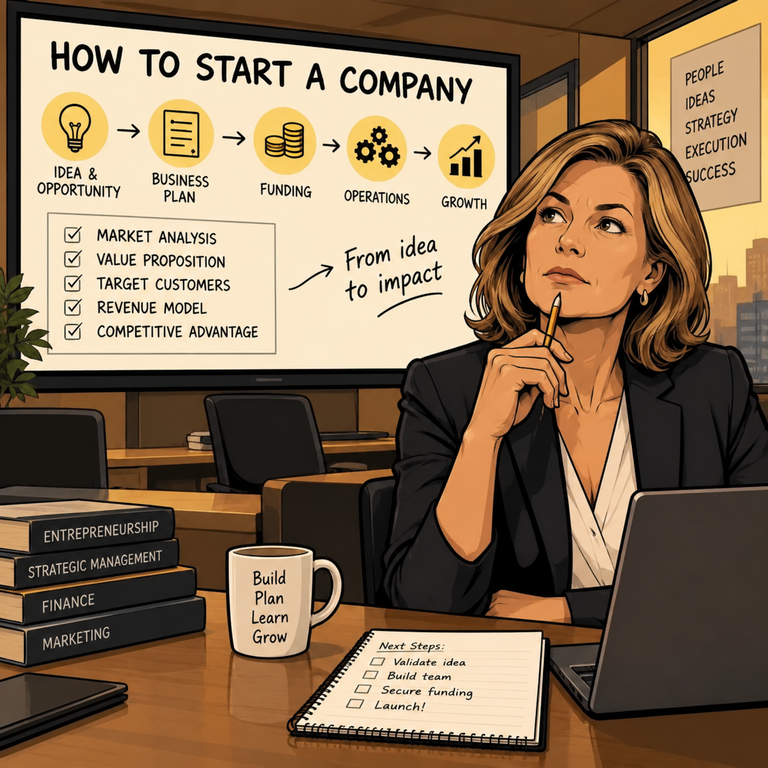
Image created using artificial intelligence; the software used was ChatGPT.
Introduction
Setting up a company is not easy, but it is not impossible. From a management perspective, before launching a business venture, we must explore five fundamental topics, which I describe below.
Business Idea and Value Proposition
You need to clarify what problem you intend to solve, for which customer, and why they should choose your specific solution. The fundamental question is: "What value do I create for the customer?" This is the starting point of the enterprise. Everything that follows will be based on this idea; in other words, all expenses incurred will be for the purpose of realizing this concept.
Business Model
The Business Model explains how the company creates, delivers, and captures value. This encompasses customers, the value proposition, sales channels, key activities and resources, partners, cost structure, and revenue streams. NOTE: Some combine the business idea with the Business Model to create a document known as a "Company Blueprint."
Feasibility Study
Here, we enter a delicate and crucial phase. The feasibility study serves to transition from the initial idea to actual figures and real-world constraints. It requires verifying commercial, technical, organizational, economic, and financial feasibility. Essentially, it answers the questions: "Can this company actually work? How much money is needed to get started?"
Business Plan and Economic-Financial Planning
We certainly do not leave the delicate phase here; on the contrary, we delve even deeper into it. Drafting a business plan and an economic-financial strategy requires a certain level of professional expertise.
At this stage, the project is translated into projected revenues, costs, investments, financial requirements, cash flows, the break-even point, and forecast scenarios.
Organization and business processes
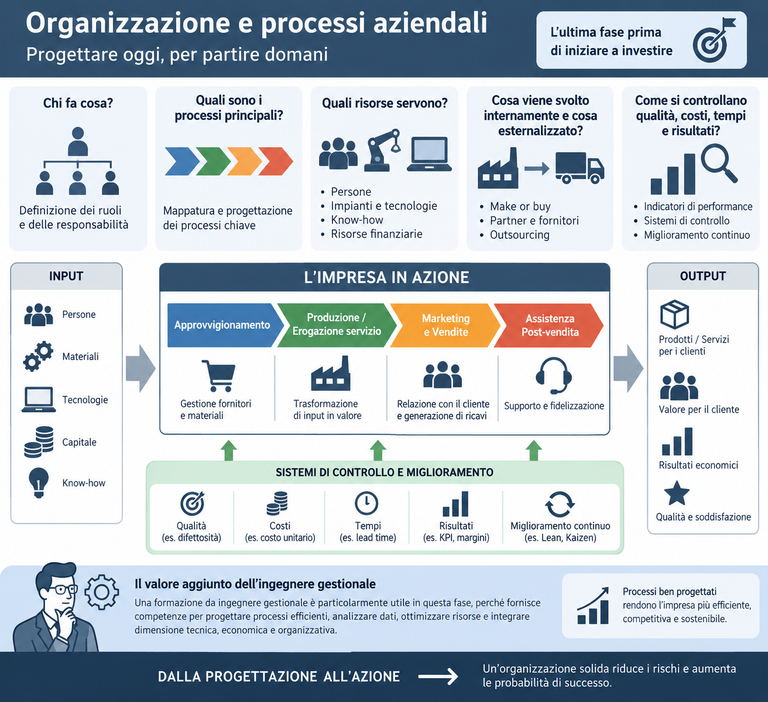
Image created using artificial intelligence (ChatGPT software)
We now arrive at what can be considered the final phase before actually spending money to launch the business.
This stage involves designing the company's practical operations: defining roles and responsibilities, identifying key processes and necessary resources, determining which tasks are handled in-house versus outsourced, and establishing how quality, costs, timelines, and results will be monitored. Individuals with a background in management engineering may have an advantage during this phase.
Conclusions
Setting up a company means progressively transforming an idea into an organized, sustainable economic system. A good insight alone is not enough; one must understand the problem to be solved, the target customers, and the value proposition.
Historical background and questions
The figure of the entrepreneur was not systematically described until the 18th century, when Richard Cantillon did so.
Did you know that it was Frederick W. Taylor who, in 1911, conceived of the company as a system of processes that could be analyzed, measured, and improved?

ITALIAN

20-09-2026-Economia e gestione delle imprese - Mettere in piedi un’azienda [EN]-[IT]
Con questo post desidero fornire una breve spiegazione sull’argomento indicato in oggetto
(codice lezione/articolo: MS_XY)
immagine creata con l’intelligenza artificiale, il software usato è ChatGPT
Introduzione
Mettere in piedi un'azienda non è facile, ma non è impossibile. A livello gestionale possiamo dire che prima di iniziare un'attività imprenditoriale dobbiamo esplorare 5 argomenti fondamentali che descrivo qui sotto.
Idea imprenditoriale e proposta di valore
Bisogna chiarire quale problema si vuole risolvere, per quale cliente e perché dovrebbe scegliere proprio la nostra soluzione. La domanda fondamentale è: «Quale valore creo per il cliente?». È il punto di partenza dell'impresa. Su questa idea si baserà tutto ciò che dovrà essere fatto, cioè, tutte le spese verranno affrontate per realizzare questa idea.
Business Model
Il Business Model spiega come l'impresa crea, distribuisce e cattura valore. Qui entrano clienti, proposta di valore, canali di vendita, attività e risorse chiave, partner, struttura dei costi e fonti di ricavo. NOTA: C'è chi unisce l'idea imprenditoriale con il Business Model facendo un documento chiamato Company Blueprint.
Studio di fattibilità
Qui entriamo in una fase delicata ed importantissima. Lo studio di fattibilità serve a passare dall'idea ai numeri e ai vincoli reali. Bisogna verificare fattibilità commerciale, tecnica, organizzativa, economica e finanziaria. In sostanza risponde alle domanda: «Questa azienda può funzionare davvero? Quanti soldi servono per partire?»
Business Plan e pianificazione economico-finanziaria
Qui non usciamo certo dalla fase delicata, anzi, entriamo ancora più a fondo della fase delicata. Per redigere un Business Plan e una pianificazione economico-finanziaria bisogna avere anche una certa professionalità.
Qui il progetto viene tradotto in ricavi attesi, costi, investimenti, fabbisogno finanziario, flussi di cassa, punto di pareggio e scenari previsionali.
Organizzazione e processi aziendali
immagine creata con l’intelligenza artificiale, il software usato è ChatGPT
Ora arriviamo a quella che possiamo considerare l'ultima fase prima di partire a spendere dei soldi per la creazione dell'impresa.
In questa fase bisogna progettare come funzionerà concretamente l'impresa: chi fa cosa, quali sono i processi principali, quali risorse servono, cosa viene svolto internamente e cosa esternalizzato, come si controllano qualità, costi, tempi e risultati. In questa fase che ha una formazione da ingegnere gestionale potrebbe essere avvantaggiato.
Conclusioni
Mettere in piedi un'azienda significa trasformare progressivamente un'idea in un sistema economico organizzato e sostenibile. Una buona intuizione, da sola, non è sufficiente: occorre capire quale problema si vuole risolvere, per quali clienti e attraverso quale proposta di valore.
Cenni storici e domande
Solo nel XVIII secolo viene descritta sistematicamente la figura dell'imprenditore e lo fa Richard Cantillon.
Sapevate che fu Frederick W. Taylor nel 1911 ha pensare l'impresa come un sistema di processi che possono essere analizzati, misurati e migliorati?
THE END
Wow, I truly enjoyed going through your blog! I like how you explained that setting up a company is more than just having a good idea. It’s true that you need to understand the problem, the customers, and the value you want to give. I once tried to start a small online selling activity, and I realized that just knowing what I wanted to sell was not enough. I had to think about who would buy it, why they would choose me, and how I could make it different from others. At first, I thought it was easy, but later I saw that planning and organizing are very important. Your post reminded me of that experience because I learned that a business needs structure to last. I also noticed that when I focused only on the product, I missed the bigger picture of how to reach people. Reading your insight makes me reflect on how important it is to balance ideas with execution. I agree that sustainability is key, because without it, the company cannot grow. Thank you for sharing this thought. I motivates me to think deeper about my own small projects and how I can improve them. 🙏
Ciao @stefano.massari, grazie mille per la spiegazione.
Io sono un pasticcione e non ho mai proceduto pienamente con gli interessanti step da te proposti.
Mi trovo ora a condurre un'azienda agricola, un agriturismo e prossimamente un agri campeggio. Puoi darmi qualche suggerimento?
i think find out who ur target ppl are, then find out what THEY want and how can u serve them. the rest will follow..