22-05-2026 - Chemistry - Heisenberg's Uncertainty Principle [EN]-[IT]

~~~ La versione in italiano inizia subito dopo la versione in inglese ~~~
ENGLISH

22-05-2026 - Chemistry - Heisenberg's Uncertainty Principle [EN]-[IT]
With this post, I would like to provide a brief introduction to the topic mentioned above.
(Lesson/Article Code: LS-05)
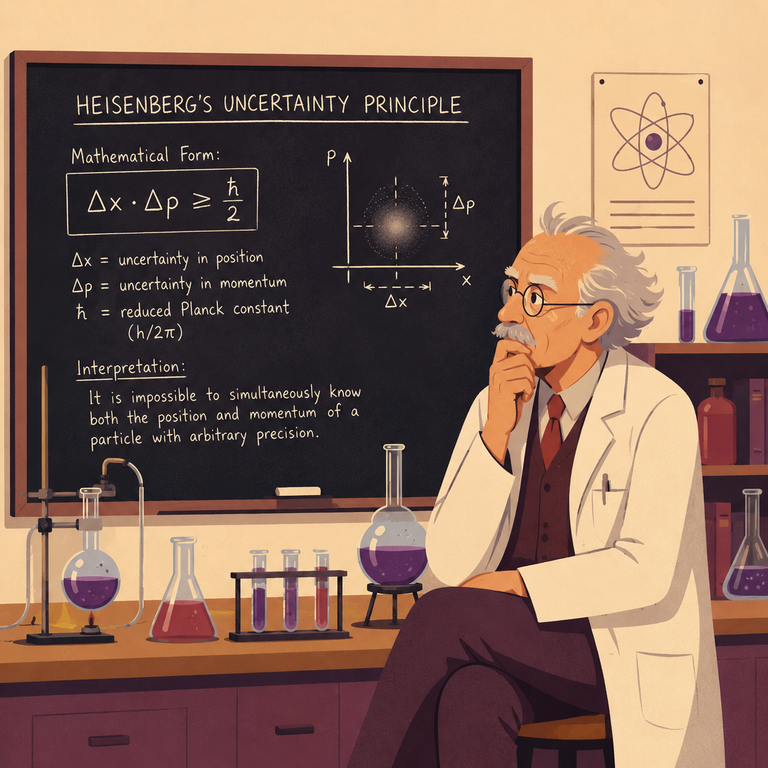
Image created with artificial intelligence, the software used is ChatGPT
Introduction to the Uncertainty Principle
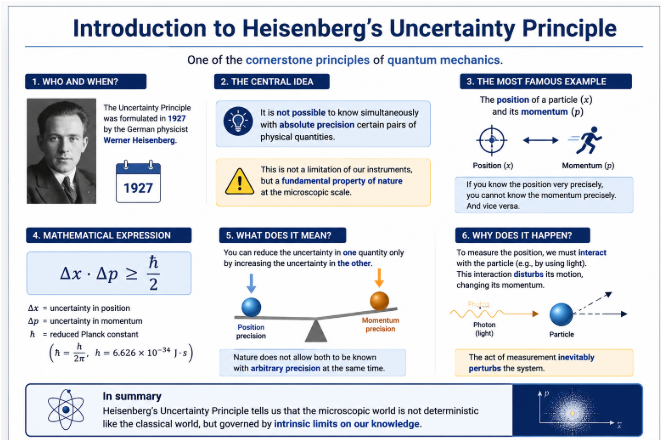
Image created with artificial intelligence, the software used is ChatGPT
The Uncertainty Principle The Heisenberg Uncertainty Principle was formulated in 1927 by German physicist Werner Heisenberg and is one of the cornerstones of quantum mechanics.
Simply put, this principle states that it is not possible to simultaneously know with absolute precision certain pairs of physical quantities, such as the position of a particle and its momentum.
Fundamental Idea of the Uncertainty Principle
In the atomic and subatomic world, if you try to measure the position of an electron with very high precision, you will lose precision regarding its velocity/momentum; however, if you measure its momentum very precisely, its position becomes uncertain.
Main formula of the uncertainty principle
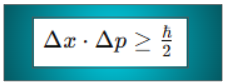
Where:
Δx = uncertainty in position
Δp = uncertainty in momentum
h = reduced Planck's constant
Note: The value of Planck's constant is h = 6.626 * 10^-34 J * s
This formula, in essence, states that the product of two uncertainties can never be zero and that there is a fundamental physical limit imposed by nature. This is not a problem with measuring instruments, but rather an intrinsic property of quantum reality.
Heisenberg's Uncertainty Principle in Everyday Practice
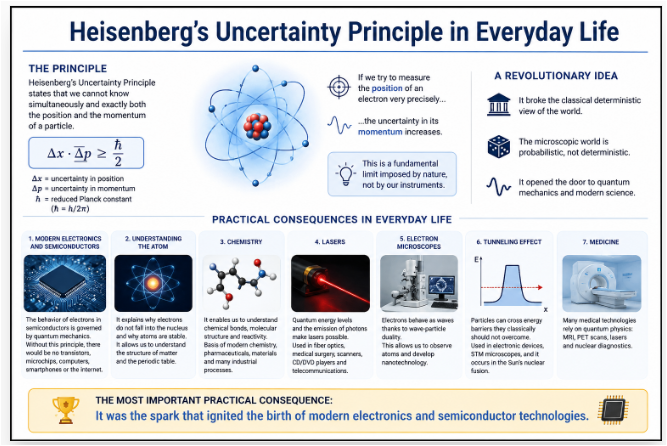
image created with artificial intelligence, the software used is ChatGPT
Werner Heisenberg's understanding of the uncertainty principle was not just a theoretical revolution. This discovery had enormous practical consequences in everyday life and modern technology.
We can say that this principle enabled us to understand the physics of the microscopic world.
That is, it clarified doubts about atoms and electrons. From there, semiconductors were developed. Studies on radiation became more precise.
Finally, it broadened the understanding of chemical bonds.
However, we can say with certainty that the most important practical consequence is probably that it was the spark for the birth of modern electronics and semiconductors.
Conclusions
Heisenberg's principle teaches us that in the quantum world, there is no simultaneous, perfect knowledge of all quantities; microscopic reality is probabilistic; the act of measurement influences the observed system.
Historical Notes and Questions
In the 1920s, classical physics was no longer able to explain several things, such as the atomic spectrum, the behavior of electrons, and the photoelectric effect.
Did you know that in 1927, things became clear, but only after Heisenberg mathematically formalized this fundamental limit of knowledge?

ITALIAN

22-05-2026 - Chimica - Il principio di indeterminazione di Heisenberg [EN]-[IT]
Con questo post vorrei dare una breve istruzione a riguardo dell’argomento citato in oggetto
(codice lezione/articolo: LS-05)
immagine creata con l’intelligenza artificiale, il software usato è ChatGPT
Introduzione al principio di indeterminazione
immagine creata con l’intelligenza artificiale, il software usato è ChatGPT
Il principio di indeterminazione di Heisenberg venne formulato nel 1927 dal fisico tedesco Werner Heisenberg ed è uno dei pilastri della meccanica quantistica.
In parole semplici questo principio afferma che non è possibile conoscere contemporaneamente con precisione assoluta alcune coppie di grandezze fisiche come la posizione di una particella e la quantità di moto della particella.
Idea fondamentale del principio di indeterminazione
Nel mondo atomico e subatomico se si cerca di misurare con grandissima precisione la posizione di un elettrone si perderà precisione sulla sua velocità/quantità di moto; se invece si misura molto bene la quantità di moto, la posizione diventa incerta.
Formula principale del principio di indeterminazione
Dove:
Δx = incertezza sulla posizione
Δp = incertezza sulla quantità di moto
h = costante di Planck ridotta
Nota: Il valore della costante di Planck è h = 6,626 * 10^-34 J * s
Questa formula, in pratica, dice che il prodotto di due incertezze non può mai essere zero ed esiste un limite fisico fondamentale imposto dalla natura. Non è un problema degli strumenti di misura, ma è proprio una proprietà intrinseca della realtà quantistica.
Il principio di indeterminazione di Heisenberg nella pratica quotidiana
immagine creata con l’intelligenza artificiale, il software usato è ChatGPT
La comprensione del principio di indeterminazione di Werner Heisenberg non fu solamente una rivoluzione teorica. Questa scoperta ebbe enormi conseguenze pratiche nella vita quotidiana e nella tecnologia moderna.
Possiamo affermare che questo principio permise di comprendere la fisica del mondo microscopico.
Cioè permise di chiarire i dubbi sugli atomi, sugli elettroni. Da qui in poi si svilupparono i semiconduttori. Gli studi sulla radiazione divennero precisi.
Infine allargò la comprensione dei legami chimici.
Possiamo però affermare con certezza che la conseguenza pratica più importante è probabilmente che esso fu la scintilla per la nascita dell'elettronica moderna e dei semiconduttori.
Conclusioni
Il principio di Heisenberg ci insegna che nel mondo quantistico non esiste una conoscenza perfetta simultanea di tutte le grandezze; la realtà microscopica è probabilistica; l’atto di misura influenza il sistema osservato.
Cenni storici e domande
Negli anni ’20 la fisica classica non riusciva più a spiegare diverse cose come lo spettro atomico, il comportamento degli elettroni e l'effetto fotoelettrico.
Sapevate che nel 1927 le cose diventarono chiare, ma solo dopo che Heisenberg formalizzò matematicamente questo limite fondamentale della conoscenza?
THE END
Amazing class sr.
Hi Galberto, thanks for leaving a comment. We can say that before Heisenberg, the electron was imagined as a small planet orbiting the nucleus along a precise orbit. The uncertainty principle demonstrated that an exact trajectory cannot be known. Consequently, the concept of an orbit was abandoned and that of an orbital was introduced, that is, a region of space where an electron is most likely to be found.
!HUG
cool. thank goodness for geniuses like this man. :) its so awesome to really add something to advance human knowledge like this..
Welcome back, Chinito. I'm very pleased to see another comment from you. In this post, I'm talking about Heisenberg's uncertainty principle. An intuitive example comes to mind right now. Imagine you want to photograph a fly in a dark room.
To see it, you have to shine a flashlight on it. But the light hits it and makes it move.
The stronger the light used to see exactly where it is, the more you alter its motion.
Heisenberg explained to us that something similar happens with electrons, but not because of limitations of the instruments: it's a fundamental property of nature.
!hiqvote
cose di cui normalmente uno non capirebbe molto 😂 questo mai sentito, o forse sentito ma dimenticato
Ciao davideownzall, è un principio complesso ma estremamente importante, sia per la chimica, sia per la tecnologia. Senza Heisenberg oggi non avremmo una spiegazione rigorosa della struttura degli atomi e delle molecole… quindi pensa a quante cose oggi non avremmo ben chiare e forse anche a quanti materiali ancora non avremmo inventato o saputo gestire.
!PIZZA
When you talk about quantum physics, I remember Jhovanoty mocking President Petro. This president attributes everything to quantum mathematics, and the comedian imitates him perfectly. Petro is an imbecile; he talks nonsense. He'll go down in history, but as the stupidest and most corrupt president ever.
Hi Lupega, For chemistry, Heisenberg's principle signified the transition from a "mechanical" view of the atom to a probabilistic one. Thanks to this principle, it was possible to develop orbital theory, understand chemical bonds, explain the periodic table, and lay the foundations of modern chemistry.
!HBIT
stefano.massari, you mined 0.9 🟧 HBIT and the user you replied to (lupega) received 0.1 HBIT on your behalf as a tip. When you mine HBIT, you're also playing the Wusang: Isle of Blaq game. 🏴☠️
Sorry, but you didn't find a bonus treasure token today. Try again tomorrow...they're out there! Your random number was 0.8352405848581343, also viewable in the Discord server, #hbit-wusang-log channel. | tools | wallet | discord | community | daily <>< Check for bonus treasure tokens by entering your username at a block explorer A, explorer B, or take a look at your wallet.There is a treasure chest of bitcoin sats hidden in Wusang: Isle of Blaq. Happy treasure hunting! 😃 Read about Hivebits (HBIT) or read the story of Wusang: Isle of Blaq.
Thanks for your contribution to the STEMsocial community. Feel free to join us on discord to get to know the rest of us!
Please consider delegating to the @stemsocial account (85% of the curation rewards are returned).
Consider setting @stemsocial as a beneficiary of this post's rewards if you would like to support the community and contribute to its mission of promoting science and education on Hive.
Congratulations @stefano.massari! You have completed the following achievement on the Hive blockchain And have been rewarded with New badge(s)
Your next target is to reach 220000 upvotes.
You can view your badges on your board and compare yourself to others in the Ranking
If you no longer want to receive notifications, reply to this comment with the word
STOP:) :)
!discovery
Ciao delilhavores, parlare del principio di indeterminazione di Heisenberg non è affatto facile, diciamo che ho fatto un tentativo. Per l’umanità è stato un passaggio importante perché ha creato la possibilità di far nascere nuove tecnologie. Da questi studi (quelli inerenti al principio di indeterminazione di Heisenberg) derivano i semiconduttori, i transistor, i laser, la risonanza magnetica e le nanotecnologie.
!DIY
This post was shared and voted inside the discord by the curators team of discovery-it
Join our Community and follow our Curation Trail
Discovery-it is also a Witness, vote for us here
Delegate to us for passive income. Check our 80% fee-back Program
Passo per scusarmi che la mia presenza è sempre più rarefatta. Ho ricominciato a studiare, dovuto alla voragine causata dalla pesante crisi del mio settore (colpa sia degli effetti del covid, che qui durano ancora e delle IA che mi stanno sostituendo), scegliendo un settore che almeno in Mercosur non conosce crisi.
!BEER
Grazie pousinha per aver lasciato un commento. In questo post ho provato a parlare del Principio di Indeterminazione di Heisenberg. L'impatto del Principio di Indeterminazione di Heisenberg sulla chimica è stato enorme. Possiamo dire che ha contribuito a trasformare la chimica da una scienza principalmente descrittiva a una scienza basata sulla meccanica quantistica. Ha posto fine all’idea delle orbite elettroniche ed ha fatto nascere la comprensione corretta dei legami chimici.
!CTP
Forte! Peccato che queste lezioni che prepari non ricevano tutti i crediti che meritano.
!PIZZA
Congratulations @stefano.massari! You received a personal badge!
Wait until the end of Power Up Day to find out the size of your Power-Bee.
May the Hive Power be with you!
You can view your badges on your board and compare yourself to others in the Ranking
Check out our last posts:
@stefano.massari qualunque cosa mi abbia risposto purtroppo non la posso vedere perchè mi esce fuori soltanto questo:

Oggi hive è piena di bugs e non dico di dCrops😣
Congratulations @stefano.massari! You received a personal badge!
Participate in the next Power Up Day and try to power-up more HIVE to get a bigger Power-Bee.
May the Hive Power be with you!
You can view your badges on your board and compare yourself to others in the Ranking
Check out our last posts:
$PIZZA slices delivered:
stefano.massari tipped davideownzall
@pousinha(1/5) tipped @stefano.massari
Send $PIZZA tips in Discord via tip.cc!