18-05-2026 - Principles of Economics - The Ten Principles of Economics [EN]-[IT]

~~~ La versione in italiano inizia subito dopo la versione in inglese ~~~
ENGLISH

18-05-2026 - Principles of Economics - The Ten Principles of Economics [EN]-[IT]
With this post, I would like to provide a brief introduction to the topic mentioned above.
(Lesson/Article Code: LS-02)
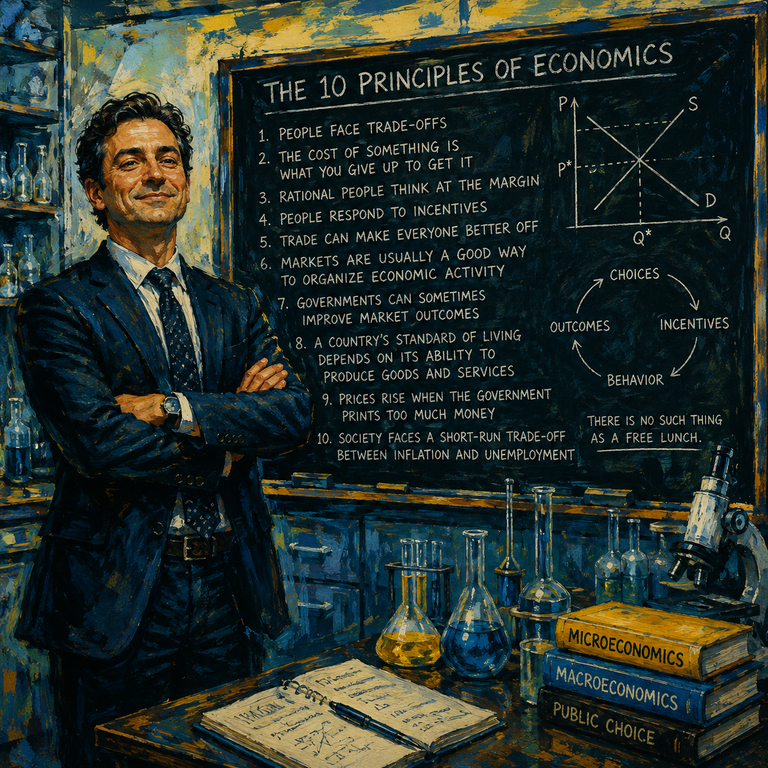
Image created with artificial intelligence, the software used is ChatGPT
Introduction to the 10 Principles of Economics
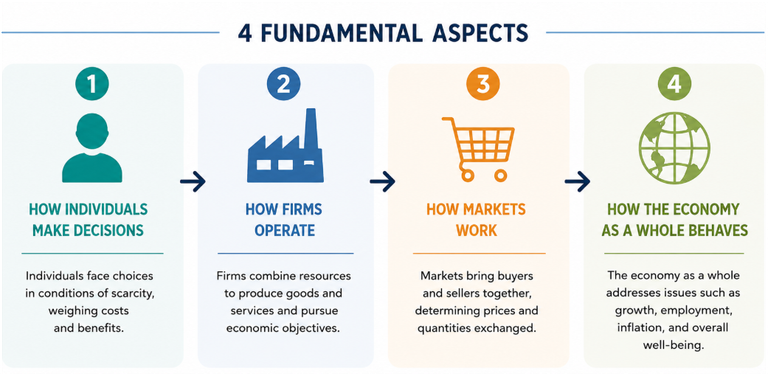
Image created with artificial intelligence, the software used is ChatGPT
In this post, I will try to discuss of the 10 principles of economics.
First of all, you might ask, what purpose do these ten principles serve?
Yeah, what purpose do they serve? It's not a simple answer.
We can say that the 10 principles of economics serve to build a sort of mental framework for understanding four fundamental aspects that revolve around an economic structure:
- how individuals make decisions
- how businesses operate
- how markets work
- how an economic system behaves as a whole
We can say that they are the logical foundations of economic analysis.
The 10 Principles of Economics
Below are the 10 principles of economics:
• Principle 1:
Decisions involve choices between alternatives (trade-offs)
• Principle 2:
The cost of something is what must be given up to get it,
called opportunity cost
• Principle 3:
Rational individuals and firms think about the margin
• Principle 4:
Individuals and firms respond to incentives
• Principle 5:
Exchange can be beneficial to everyone (Pareto optimality)
• Principle 6:
Markets are usually an effective tool for
organizing economic activity
• Principle 7:
Sometimes government intervention can improve the outcome
produced by the market
• Principle 8:
A country's standard of living depends on its capacity to
produce goods and services
• Principle 9:
Prices rise when the government prints too much money
• Principle 10:
Society faces a Short-run trade-off between
inflation and unemployment.
Below, I'll discuss the three principles that I personally believe are the most important to understand.
1-Decisions involve choices between alternatives
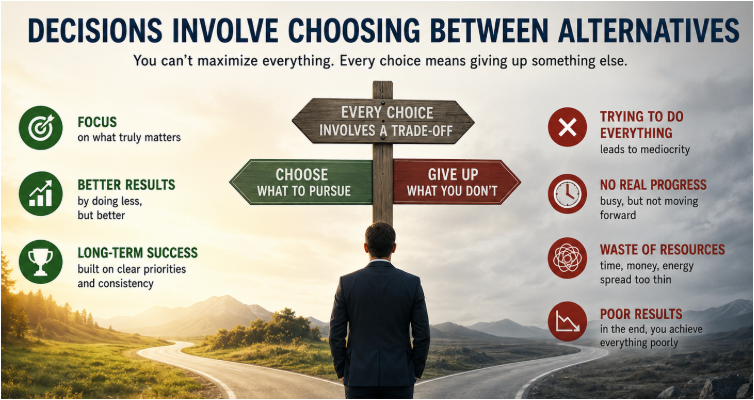
Image created with artificial intelligence, the software used is ChatGPT
The first principle is extremely important. This principle states that "Decisions involve choices between alternatives." The concept is immediately obvious and seems simple, but in reality, very few people respect this principle.
The profound meaning of this principle is that you can't maximize everything at the same time. In economics, choices must be made with alternatives, and this means deciding what to pursue and what to forgo. It must be clear from the outset that choices involve sacrifices. How many times have we seen companies make a choice between two alternatives and then the next day implement both the "first choice" and the alternatives? Only to end up doing everything poorly!
2-The cost of something is what you have to give up to get it
In second place, I put what is considered the second principle.
The cost of something is what you give up to get it (opportunity cost).
How many times have you heard managers talk about "opportunities" when faced with a problem? 100? 1,000?
It's wrong... I repeat, WRONG!!!!
Opportunities don't exist in economics or business economics; there's what's called "opportunity cost."
We can say that the concept, expressed simply, is that if a company uses a machine to produce A, it gives up producing B.
What is called an opportunity has a cost and also includes:
- wasted time
- sacrificed alternative
- lost profit
Therefore, there is not an opportunity, but an opportunity that has a cost, and addressing it means having done the math to understand when this cost will be recovered. Therefore, it is not only necessary to be clear about the cost, but also about the cost recovery plan.
8- A country's standard of living depends on its capacity to
produce goods and services
Now, in third place, in terms of importance, I would have placed point 8.
This is a very important principle because in a capitalist system, in the long run, a country's wealth depends on its productivity.
In a nation, technology, innovation, education, and industrial organization have a significant impact on a nation's productivity.
You can't live on air, a good standard of living doesn't grow on trees, but it's a country's productivity that makes us live well.
Conclusions
We can conclude by saying that the 10 principles of economics represent the foundation through which we can understand the behavior of individuals, businesses, markets, and the entire economic system.
Historical Notes and Questions
The 10 principles of economics did not all emerge at a single historical moment. However, we can say that the birth of modern economics is generally linked to 1776, the year Adam Smith published his book "The Wealth of Nations."
Did you know that although Adam Smith is considered the "father of modern economics," he was actually first and foremost a moral philosopher?

ITALIAN

18-05-2026 - Principi di economia - I dieci principi dell’economia [EN]-[IT]
Con questo post vorrei dare una breve istruzione a riguardo dell’argomento citato in oggetto
(codice lezione/articolo: LS-02)
immagine creata con l’intelligenza artificiale, il software usato è ChatGPT
Introduzione sui 10 principi dell'economia
immagine creata con l’intelligenza artificiale, il software usato è ChatGPT
In questo post proverò a parlare dei 10 principi dell'economia.
Innanzitutto vi chiederete, ma a cosa servono questi dieci principi??
EEhhh già, a cosa servono? Non è una risposta semplice.
Possiamo dire che i 10 principi dell'economia servono a costruire una sorta di struttura mentale per comprendere 4 cose fondamentali che ruotano attorno ad una struttura economica:
-come prendono decisioni gli individui
-come operano le imprese
-come funzionano i mercati
-come si comporta un sistema economico nel suo insieme
Possiamo dire che sono i fondamenti logici dell’analisi economica.
I 10 principi dell'economia
Qui di seguito elenco i 10 principi dell'economia:
• Principio 1:
Le decisioni comportano scelte fra alternative (trade-off)
• Principio 2:
Il costo di qualcosa è ciò a cui si deve rinunciare per ottenerlo,
cosiddetto costo opportunità (cost opportunity)
• Principio 3:
Gli individui e le imprese razionali pensano al margine
• Principio 4:
Gli individui e le imprese rispondono agli incentivi
• Principio 5:
Lo scambio può essere vantaggioso per tutti (Pareto ottimale)
• Principio 6:
I mercati sono di solito uno strumento efficace per
organizzare l’attività economica
• Principio 7:
A volte l’intervento dello Stato può migliorare il risultato
prodotto dal mercato
• Principio 8:
Il tenore di vita di un paese dipende dalla sua capacità di
produzione di beni e servizi
• Principio 9:
I prezzi aumentano quando lo Stato stampa troppa moneta
• Principio 10:
La società si confronta con un trade-off di breve periodo tra
inflazione e disoccupazione.
Qui di seguito andrò a parlare dei 3 principi che io personalmente ritengo i più importanti da comprendere.
1-Le decisioni comportano scelte fra alternative
immagine creata con l’intelligenza artificiale, il software usato è ChatGPT
Il primo principio è di un importanza estrema. Questo principio afferma che "Le decisioni comportano scelte fra alternative". Il concetto arriva subito e sembra anche semplice, ma in realtà, sono in pochissimi che rispettano questo principio.
Il significato profondo di questo principio è che non si può massimizzare tutto contemporaneamente. In economia vanno fatte delle scelte con delle alternative e questo significa che bisogna decidere cosa portare avanti e cosa rinunciare. Da subito deve essere chiaro che la scelta implica delle rinunce. Quante volte abbiamo visto in ambito aziendale prendere una scelta tra due alternative e poi il giorno dopo eseguire sia la "prima scelta" ed anche le alternative? Riuscendo poi alla fine fare tutto male!
2-Il costo di qualcosa è ciò a cui si deve rinunciare per ottenerlo
Al secondo posto metto quello che è considerato il secondo principio.
Il costo di qualcosa è ciò a cui si rinuncia per ottenerlo (costo opportunità).
Quante volte avete sentito che di fronte ad un problema i responsabili parlano di "opportunità"? 100? 1000?
E' sbagliato... ripeto SBAGLIATO!!!!
Non esistono le opportunità in economia o in economia aziendale, esiste quello che viene chiamato "costo opportunità".
Possiamo dire che il concetto, espresso in parole povere è che se un’impresa usa una macchina per produrre A, rinuncia a produrre B.
Quella che viene chiamata opportunità ha un costo e conta anche:
-tempo perso
-alternativa sacrificata
-profitto mancato
Quindi non esiste un'opportunità, ma un'opportunità che ha un costo ed affrontarla significa che si sono fatti anche i conti per capire quando questo costo verrà recuperato. Quindi non bisogna essere chiari solo sul costo, ma anche sul piano di recupero dei costi.
8-Il tenore di vita di un paese dipende dalla sua capacità di
produzione di beni e servizi
Ecco, al terzo posto, a livello di importanza io ci avrei messo il punto 8.
Questo è un principio importantissimo perché in un sistema capitalistico Nel lungo periodo la ricchezza di un paese dipende dalla sua produttività.
In una nazione tecnologia, innovazione, istruzione e organizzazione industriale agiscono in maniera incisiva sulla produttività di una nazione.
Non si campa di aria, un buon tenore di vita non cresce sugli alberi, ma è la produttività di un Paese che ci fa vivere bene.
Conclusioni
Possiamo concludere dicendo che i 10 principi dell’economia rappresentano le fondamenta attraverso cui è possibile comprendere il comportamento degli individui, delle imprese, dei mercati e dell’intero sistema economico.
Cenni storici e domande
I 10 principi dell’economia non sono nati tutti insieme in un unico momento storico. Possiamo però dire che la nascita dell’economia moderna viene generalmente collegata al 1776, anno in cui Adam Smith pubblicò il libro "La ricchezza delle nazioni".
Sapevate che nonostante Adam Smith sia considerato il “padre dell’economia moderna” lui in realtà era prima di tutto un filosofo morale?
THE END
E più avanti si va e più saranno penso! O quantomeno dovranno modificarsi
Yesterday I saw a video where many workers were laid off. They're doing a test with several robots. These robots have to work checking that the packages being shipped are in perfect condition. The robots do it faster than humans, so the company decides to lay off more people and buy more robots.
Now wars seem to be happening more and more, the economy is moving, maybe that's what they're aiming for.
We have to be focused on finding the best way to achieve our own financial stability; the future doesn't look good, or maybe I'm just being overly dramatic.
of these, to me, wasted time is most important.