Book: $100M Offers - Alex Hormosi (chapter 10)

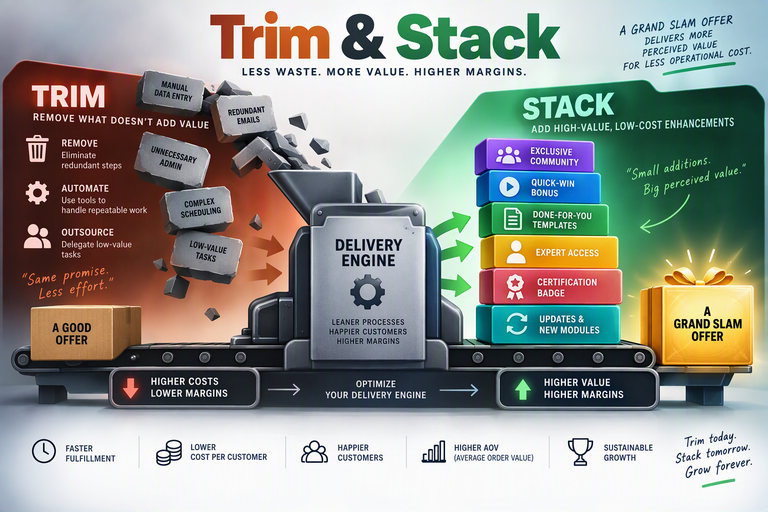
Now that you have a solid set of core promises (Chapter 9), the next step is to optimize the delivery engine so you can fulfill those promises at the highest possible margin. Hormozi’s “Trim & Stack” framework teaches you to remove waste (trim) and add strategic, high‑value, low‑cost enhancements (stack) that widen the value‑price gap without inflating your workload.
The philosophy behind Trim & Stack
- Trim focuses on efficiency: identifying steps in your fulfillment process that consume time or money but do not increase the customer’s perceived value. Cutting or automating these steps lowers cost and frees capacity for growth.
- Stack focuses on value amplification: adding elements that are inexpensive for you to provide but feel highly valuable to the customer (e.g., exclusive community access, a quick‑win bonus, a personalized touch). These stack items boost the numerator of the Value Equation without significantly increasing the denominator.
When done together, you can often raise price while maintaining or improving margins—the exact condition Hormozi describes for a Grand Slam Offer.
Step‑by‑step Trim process
Map your current fulfillment workflow
Create a flowchart (paper, whiteboard, or digital tool) that shows every action from the moment a customer pays to the moment they receive the promised result. Include:- Order processing / payment confirmation
- Delivery of digital assets (download links, access codes)
- Onboarding steps (welcome email, schedule call, questionnaire)
- Core service delivery (coaching sessions, software access, consulting work)
- Post‑delivery follow‑up (feedback request, upsell offer)
- Administrative tasks (invoicing, refund handling, data entry)
Label each step with two scores (1‑5)
Score Meaning Value Impact How much does this step increase the customer’s perceived value or satisfaction? (1 = none, 5 = essential to the promise) Cost/Effort How much time, money, or complexity does this step require from you or your team? (1 = negligible, 5 = heavy) Estimate these scores based on past experience, time‑tracking data, or quick team estimates.
Identify Trim candidates
Look for steps that fall into the low‑Value, high‑Cost quadrant (bottom‑right of a simple 2×2 grid). These are prime targets for removal or automation.- Examples of common trim items:
- Manual data entry of customer info into a spreadsheet (could be replaced by a Zapier‑CRM integration).
- Sending individual welcome emails one‑by‑one (automate with an email sequence).
- Scheduling calls via back‑and‑forth emails (use Calendly or similar).
- Providing generic PDF manuals that customers never read (replace with short video walkthroughs).
- Handling refunds through a lengthy manual process (implement a self‑serve portal with clear policy).
- Examples of common trim items:
Decide: Remove, Automate, or Outsource
- Remove – if the step truly adds no value and can be omitted without affecting the promise (e.g., a redundant survey).
- Automate – if the step is repeatable and rule‑based (use Zapier, Make.com, Integromat, or native platform automations).
- Outsource – if the step requires specialized skill but is low‑value for your core team (hire a VA for data entry, a designer for simple graphics).
Document the change, estimate the time/cost saved, and verify that the core promise remains intact.
Re‑measure after trimming
- Track fulfillment time per customer (from purchase to delivery of core promise).
- Track cost per customer (software subscriptions, labor hours, third‑party fees).
- Aim for at least a 20‑30 % reduction in either time or cost without a drop in satisfaction (measure via a quick NPS or CSAT survey).
Step‑by‑step Stack process
Brainstorm potential stack items
Use the same problem‑solution list from Chapters 8‑9, but this time look for add‑ons that:- Solve a secondary pain or enhance the dream outcome.
- Are low cost to you (e.g., a piece of content you already have, a community you’re already building, a template you can reuse).
- Are high perceived value for the customer (they feel like a bonus, not a commodity).
Common stack ideas:
Stack type Example Approx. cost to you Perceived customer value Exclusive community Private Slack/Discord channel Moderate (setup + occasional moderation) High (peer support, networking) Quick‑win bonus 5‑minute video “first‑step guide” Low (reuse existing content) Medium‑High (instant gratification) Done‑for‑you template Customizable contract or proposal template Low (one‑time creation) High (saves time) Expert access One‑office‑hour “Ask Me Anything” call per month Low‑Medium (your time) High (personal touch) Certification badge Downloadable certificate upon completion Low (design) Medium (social proof) Updates / new modules Quarterly refresher lesson Low‑Medium (content creation) High (ongoing value) Score each stack idea
Use the same 1‑5 scales, but reverse the axes for stacking:- Value Impact (how much does it increase perceived value? 1‑5).
- Cost/Effort (how much does it add to your workload? 1‑5).
Prioritize items with high Value Impact and low Cost/Effort (top‑left quadrant).
Test stack items with a micro‑audience
- Select one stack candidate.
- Create a simple A/B test:
- Version A – core offer only (as trimmed).
- Version B – core offer + the stack item.
- Drive equal traffic (e.g., $15 ad spend each) to your starving crowd.
- Measure conversion rate, average order value (AOV), and post‑purchase satisfaction (NPS or CSAT).
If Version B shows a statistically significant lift in AOV (≥ 10 %) and conversion does not drop, keep the stack item. If conversion suffers, reconsider the item’s relevance or presentation.
Integrate winning stacks
- Add the stack item to your standard offer description, sales page, and onboarding sequence.
- Update any pricing or packaging to reflect the added value (you may keep price the same or increase it slightly, depending on the lift).
- Document the stack item’s delivery process so it becomes repeatable.
Iterate
After each successful stack, return to step 1 and look for the next high‑impact, low‑cost add‑on. Over time you’ll build a stacked offer that feels far more valuable than the sum of its parts, while your marginal cost per customer stays low.
Trim & Stack in action: a concise case study
Business: Monthly subscription for social‑media content templates targeting small‑business owners.
Initial workflow:
- Payment → automated receipt.
- Manual email with a ZIP file of 30 templates (created each month by designer).
- Follow‑up email asking for feedback (manual).
- Monthly live Q&A (hosted by founder, 1 hr).
Trim findings:
- Step 2 (manual ZIP email) – high effort (designer time each month), moderate value (templates are the core). Solution: Switch to a self‑serve portal where customers log in and download the current month’s pack automatically (designer uploads once, no per‑customer email).
- Step 3 (manual feedback email) – low value, low effort → changed to an in‑app feedback pop‑up after download (automated).
Stack findings:
- Exclusive community (private Facebook group) – moderate setup cost, high perceived value (networking, idea sharing).
- Monthly mini‑workshop (15‑minute live demo of new templates) – low extra cost (founder already does Q&A), high perceived value (shows how to use the templates).
Results after implementation (3‑month test):
- Fulfillment time per customer dropped from 10 min (manual email) to < 2 min (portal login).
- Labor cost per customer fell from $4 to $0.50.
- Adding the community + mini‑workshop raised AOV from $29 to $38 (+31 %).
- Conversion stayed steady at 4.2 % (no negative impact).
Quick checklist for Trim & Stack
Trim
- [ ] Map the end‑to‑end fulfillment flow.
- [ ] Score each step for Value Impact vs. Cost/Effort.
- [ ] Identify low‑Value/high‑Cost steps.
- [ ] Decide to remove, automate, or outsource each.
- [ ] Re‑measure time/cost per customer; aim for ≥ 20 % improvement.
Stack
- [ ] Brainstorm low‑cost/high‑value add‑ons from your problem‑solution list.
- [ ] Score each for Value Impact vs. Cost/Effort.
- [ ] Pick the top candidate; run an A/B test against core‑only offer.
- [ ] Keep the stack if AOV ↑ ≥ 10 % with no conversion drop.
- [ ] Document the stack’s delivery process.
- [ ] Repeat to build a stacked offer over time.
By systematically trimming waste and stacking valuable, low‑effort enhancements, you transform a decent offer into a Grand Slam Offer that delivers more perceived value for less operational cost—exactly the equation Hormozi shows leads to unstoppable growth.